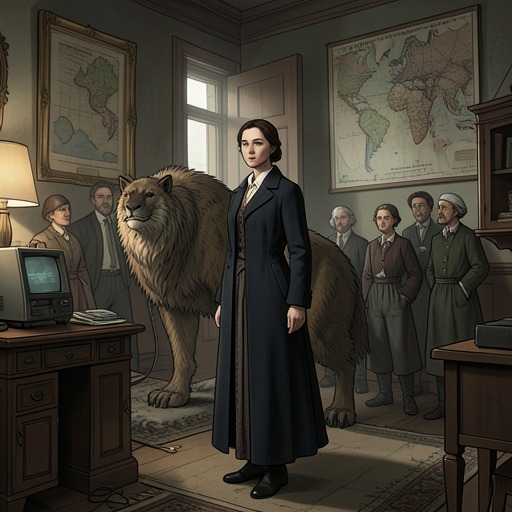
Whitby Dragon Egg Hatching Incident
The RookThe Whitby Dragon Egg Hatching Incident begins as a rare opportunity to observe a creature believed extinct and becomes a lethal reversal of the Checquy’s carefully staged experiment. Noel Bittner expects to bond psychically with the dragon; instead, the newly hatched animal kills him, defeats the armed response, and is stopped only by Pawn Monica Jarvis-Reed’s arrival from four miles above the site.
Discovery and Purpose
The incident grows out of a dragon egg laid in North Yorkshire. The Checquy had no confirmed dragon sighting for centuries; the last known period of their presence coincided with the Little Ice Age. Earlier records described dragons in extreme cold, and the region’s history of flying reptiles lent the discovery a further, uncertain context: people had found pterodactyl skeletons there, along with dragon remains once classified as a pterodactyl subspecies.
An operative, Yves Tyerman, had witnessed and recorded the egg’s laying. The Court in London accepted his report, which was then filed away for hundreds of years. Because dragons bury their eggs deep, the Checquy undertook a discreet archaeological dig to recover it. The hatching was therefore not simply an unexpected encounter; it was the culmination of a discovery preserved in institutional records and deliberately brought back into view.
The Checquy also expected the event to test Bittner’s unusual claim. He said he had already touched minds with the dragon and would establish a psychic rapport when it emerged, forming a bond with it. The scale of the planned observation reflected both the rarity of the event and the danger the organization anticipated: a Rook, a Chevalier, a Bishop, and the Lord were to attend, alongside Bittner and a large support team.
The Hatching and Failed Bond
The egg stood in a courtyard under spotlights, surrounded by viewing galleries where technicians, biologists, historians, and a camera crew watched. Checquy troops armed with assorted weapons lined the roof. The historical texts offered little practical guidance: no one in recorded history had managed to kill a dragon. Behind reinforced glass, the Court’s party watched while Bittner approached the egg along a wooden walkway, wearing a robe and carrying a hands-free radio so his reactions could be recorded.
As the egg began to move, Myfanwy Thomas sensed the creature’s muscular activity through her own body. Her fingers curled involuntarily, and she felt an impulse to spread wings and cry out. The emerging dragon cut through the shell with controlled strokes, opened it in thick sections, and unfolded from a mass of brown scales. Its long neck rose, its limbs extended, and its large wings spread above the courtyard. The scene fulfilled the promise of a living dragon, but it also made the observers’ distance and weapons seem precarious.
The dragon’s first cries followed the opening of its eyes and its first exposure to air. Bittner had fallen silent, and the observers could see the egg rocking before the creature broke free. When the dragon turned toward the assembled personnel, Bittner insisted that they must not attack because he and the dragon were bonding. His confidence ended abruptly: the dragon killed him before he could finish explaining the rapport he claimed they shared. The central assumption of the experiment—that a psychic connection would make the hatchling approachable—was overturned at the moment it mattered most.
Failed Containment and Intervention
After Bittner’s death, the viewing room erupted in alarm. Anthony tried to guide Myfanwy away, while Breeshey Cahill called for an attack over the radio. The troops fired into the courtyard, but their bullets ricocheted from the dragon, which remained unharmed. Smoke obscured it briefly; then its fire reached the viewing area, and the surviving observers could see that the soldiers had been killed. The dragon began feeding on one of the fallen guardsmen, establishing that the response had failed not merely to control it but to protect the people surrounding it.
Cahill ordered the shutters closed, cutting off the party’s view of the courtyard. The impact from above then shook the shutters and cracked the reinforced glass. When the shutters were opened again, the dragon lay dead, its head severed cleanly from its body. Monica Jarvis-Reed, a Pawn whose body was indestructible, stood beside it. She had arrived from four miles above the site, wearing only clothes that could easily be laundered; her intervention, rather than the weapons prepared for the event, ended the threat.
Consequences and Significance
The outcome dismantles the Checquy’s expectations in quick succession: an archived report becomes a living, dangerous event; Bittner’s promised bond fails; the military response cannot injure the dragon; and the decisive force comes from Jarvis-Reed’s extraordinary body. The plan had brought experts, officials, recording equipment, and armed troops together to observe and contain a creature whose biology remained poorly understood. Their apparatus documented the event, but did not make it manageable.
The incident also marks a sudden reversal in the dragon’s status. It had been treated as the surviving representative of a vanished lineage, an object of historical study and anticipation. Once hatched, it acts independently of the human interpretation imposed on it: Bittner’s belief in a mutual bond does not determine its behavior, and the Checquy’s preparations cannot guarantee its containment. The event ends with the dragon dead and the evening abandoned, leaving the spectacle of its return inseparable from the cost of confronting it.